
Unit 1: Theories, Policies and Practices
Reflection
Over the past year of teaching on the MA programme, I have been reflecting more deeply on how embodied and sensory forms of knowledge can sit alongside theoretical learning within (and beyond) the classroom. My own artistic practice has long explored the relationship between the body, narrative and lived experience, and increasingly I am interested in how these approaches might inform my pedagogical practice. In particular, I have been thinking about how embodied learning might function as part of what Lee Shulman describes as a signature pedagogy — a way of structuring learning that shapes how students come to think, act and understand within a discipline.
In art, design and creative research contexts, knowledge is rarely produced through text alone. It emerges through making, sensing, observing and relating to the world. Yet within higher education, theoretical texts can often feel intimidating or inaccessible, particularly for students who are working in a second language or who have come from educational systems that centre more didactic modes of learning. For this reason, I have been experimenting with ways of integrating embodied exercises into workshops as a means of opening up different entry points into theory.
A recent example of this took place during a workshop I facilitated for the Co-design for Sustainable Future unit within MA Design for Social Innovation and Sustainable Futures. In this session we explored Tema Okun’s text White Supremacy Culture – Still Here. Rather than approaching the text purely through discussion, students were invited to interpret particular characteristics through embodied “sculptures” or postures created in small groups. They then transformed these into new embodied forms that represented possible antidotes. Later, we discussed various liberatory practices that show up in the works of creative practitioners who tend toward projects that highlight antidotes to these characteristics in some shape or form. We created a shared Padlet for this, so that students and other MADSISF course lecturers could add links to references that felt relevant to the antidotes of white supremacy culture that we explored in class.
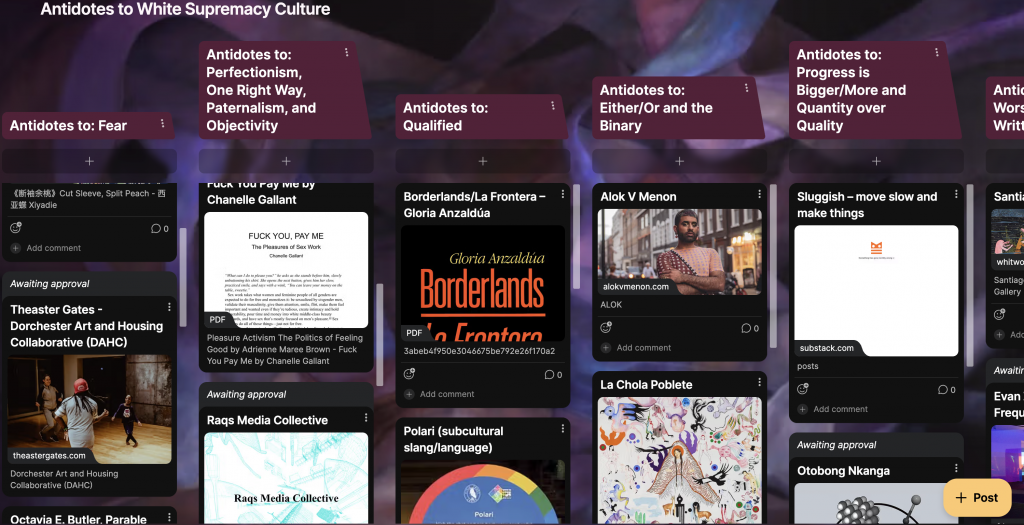
Figure 1. Miller, S. (2026) Screenshot of Padlet board created as a shared resource for the the Liberated to the Bone workshop as part of Unit 4 with the MA Design for Social Innovation and Sustainable Futures students.[photograph]. Author’s own.
The intention behind this exercise was not to replace textual analysis but to supplement it. By translating abstract concepts into physical form, students were able to encounter the ideas through sensation, gesture and spatial relation. In discussion afterwards, many students reflected that the physical act of representing the concepts helped them recognise how such cultural traits might appear in everyday behaviours, in themselves, others and institutional environments. In this sense, embodied learning became a way of supporting theoretical comprehension for the group.
At the same time, this approach does raise important considerations when working with an international cohort. I’m aware that not all students have previously encountered somatic or experiential methods within formal education, and some may initially feel uneasy about engaging in embodiment exercises within an academic context. For this reason, I try to frame these activities carefully, emphasising that they are invitations rather than expectations and that there are multiple ways of engaging and participating. Creating smaller group settings and allowing time for reflection can also help students to build confidence gradually whilst also being a tool for connection.
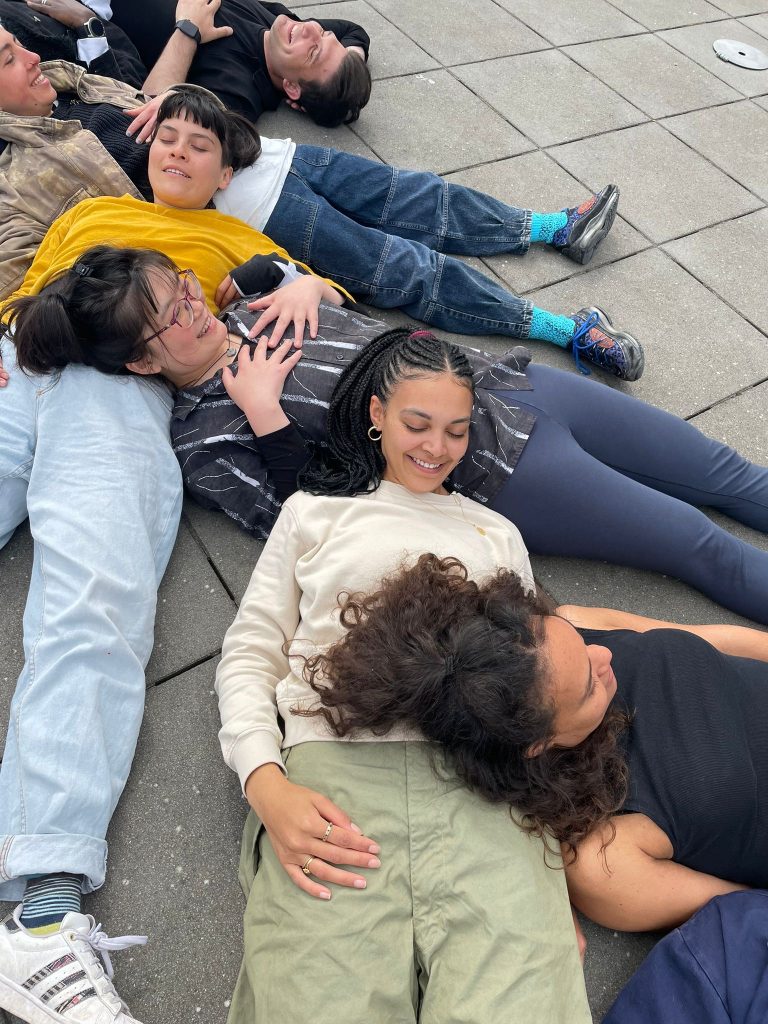
Figure 2. Miller, S. (2022) Photograph of myself and other peers from my MA cohort during a clowning workshop at Sandberg Instituut in Amsterdam, The Netherlands.[photograph]. Author’s own.
bell hooks writes about the classroom as a space where the mind and body are not separated, but where learning can emerge through lived experience and collective dialogue. This resonates strongly with my own approach to teaching. When embodied and sensory practices are introduced thoughtfully, they can expand students’ understanding of what counts as knowledge. They also allow theoretical ideas to be encountered not only intellectually but relationally and affectively.
Moving forward, I hope to continue exploring how embodied learning might function as a meaningful pedagogical strategy within creative education — not as an alternative to theory, but as another pathway through which students can engage with it. I would like to continue experimenting with ways of integrating somatic practices into the classroom, as a means of connecting theoretical concepts to lived experience and what Donna Haraway describes as situated knowledges — forms of understanding that are shaped by our specific embodied, social and cultural positions (Haraway, 1988). In this sense, I hope that embodied learning can offer a way for students to recognise knowledge not as abstract or universal, but as something relational, partial and grounded in their own interconnected experience.
In the next iteration of this workshop (or one similar), I plan to intentionally build in more moments of reflection where students can articulate how the embodied exercises are shaping their understanding of the theory. I would also like to gather informal feedback from students on how accessible and meaningful these approaches feel, particularly for those less familiar with somatic methods.
References
Haraway, D. (1988) ‘Situated knowledges: The science question in feminism and the privilege of partial perspective’, Feminist Studies, 14(3), pp. 575–599.
hooks, b. (1994) Teaching to Transgress: Education as the Practice of Freedom. New York: Routledge.
Okun, T. (2021) White Supremacy Culture – Still Here. Available at: https://www.whitesupremacyculture.info (Accessed: 11 March 2026).
Shulman, L. (2005) ‘Signature pedagogies in the professions’, Daedalus, 134(3), pp. 52–59.
Images
Figure 1. Miller, S. (2026) Screenshot of Padlet board created as a shared resource for the the Liberated to the Bone workshop as part of Unit 4 with the MA Design for Social Innovation and Sustainable Futures students.[photograph]. Author’s own.
Figure 2. Miller, S. (2022) Photograph of myself and other peers from my MA cohort during a clowning workshop at Sandberg Instituut in Amsterdam, The Netherlands.[photograph]. Author’s own.